11th grade · Stanford Online High School

Etienne Pema La Fleur

I like simple questions with surprising answers, and the math it takes to uncover them.

I research networks using graph theory with a UNR math professor, have written two papers through Euler Circle, publish a twice-monthly math newsletter, and compete in FIRST Robotics, where my team reached the World Championship in 2026.

Etienne Pema La Fleur in front of a painted mural
Research

How Network Structure Shapes Epidemics

Comparing random, small-world and scale-free contact networks with SIR simulations

With Dr. Deena Schmidt, Department of Mathematics and Statistics, University of Nevada, Reno · Fall 2026

I simulate outbreaks on 500-person contact networks (random, small-world, and scale-free) to ask which structural properties, beyond the average number of contacts, predict how large and how fast an epidemic gets. Building on Ames et al. (2011) and Pérez-Ortiz et al. (2022), early results suggest that clustering, not the distance between people, keeps outbreaks small, and that global efficiency is the best single predictor. Next: separating clustering from the spread in contacts.

In progress

p-adic Pseudorandom Number Generators

Euler Circle · Spring 2026

A pseudorandom number generator turns a seed into a sequence that looks random. I build one by repeatedly applying a function on the p-adic integers, a number system that matches how computers do arithmetic at a fixed precision. Using a theorem of Anashin, I show how to check, one modulus at a time, that the generator gives uniform output and the longest possible period at every precision. I also show what this approach cannot give: unpredictability, which cryptography needs.

Read the paper (PDF)

Fourier Analysis Through the Lens of Linear Algebra

Euler Circle · March 2026

Fourier analysis rests on the claim that a broad class of functions can be written as an infinite sum of sines and cosines. I argue that both the claim and the coefficient formulas become natural once viewed through linear algebra: the integral of a product of two functions behaves like a dot product, the trigonometric functions form an orthogonal set, and the coefficient formulas follow from the same orthogonal projection used for vectors in Rn.

Read the paper (PDF)

AI and the Future of Work: Analyzing Job Exposure to Generative AI

Inspirit AI Scholars Program · Summer 2026 · Inspirit AI Scholar certificate

In a six-person team, we studied how AI is changing jobs, using occupation data from O*NET and job-posting trends from Indeed. Each of us built an app; mine, the AI Insight Dashboard, is an interactive dashboard showing which jobs AI affects and by how much, and whether it automates tasks or helps people do them better. Our takeaway: AI is changing jobs more than replacing them.

Projects

Code projects

slang-half-life

How long does a slang term live? I measure the rise, peak, and decay of Gen-Z slang from Wiktionary lookups.

Python

life-and-money

Does wealth buy a longer life? A World Bank cross-country study: the Preston curve, what predicts life expectancy, and which countries beat the odds.

Python

star-signals

Does GitHub reward substance or surface signal? An ML study of what predicts a repository's stars.

Python

honest-backtester

A portfolio backtester built around the ways a backtest can fool you: no lookahead, walk-forward validation, and bootstrap significance.

Python

spread

A puzzle app about how things spread through graphs.

TypeScript

composite

A math whiteboard with a library and shared symbols.

TypeScript

quantkit

A small quant toolkit: keyless data loaders, return metrics, factor regressions, and a clean matplotlib style.

Python

More on GitHub →

Interactive notebooks

Short data stories on markets, money and the economy, with charts you can explore, built on Observable.

All notebooks on Observable →

Coursework

University-level courses

Stanford Online High School

  • Discrete Mathematics
  • Real Analysis
  • Data Structures and Algorithms

University of Nevada, Reno

  • Linear Algebra
  • Principles of Microeconomics

UC San Diego Extension

  • Multivariable Calculus
  • Java Programming II
  • General Biology II
  • General Physics I

I also took AP United States History and AP English Language (BYU).

Competition math
  • 20262nd place, Nevada State Mathematics Championship, Level 4 (grades 9 and 10), and 1st place team
  • 20261st place, ARML local competition (grades 9 to 12)
  • 20261st place, MathRocks season standings, NVMath (grades 9 to 12, 2025 to 2026 season)
  • 20255th place, Nevada State Math Championship (grades 9 to 12)
  • 20257th place, ARML local competition; member of the NVMath ARML team
  • 20254th place, MathRocks season standings, NVMath (2024 to 2025 season)

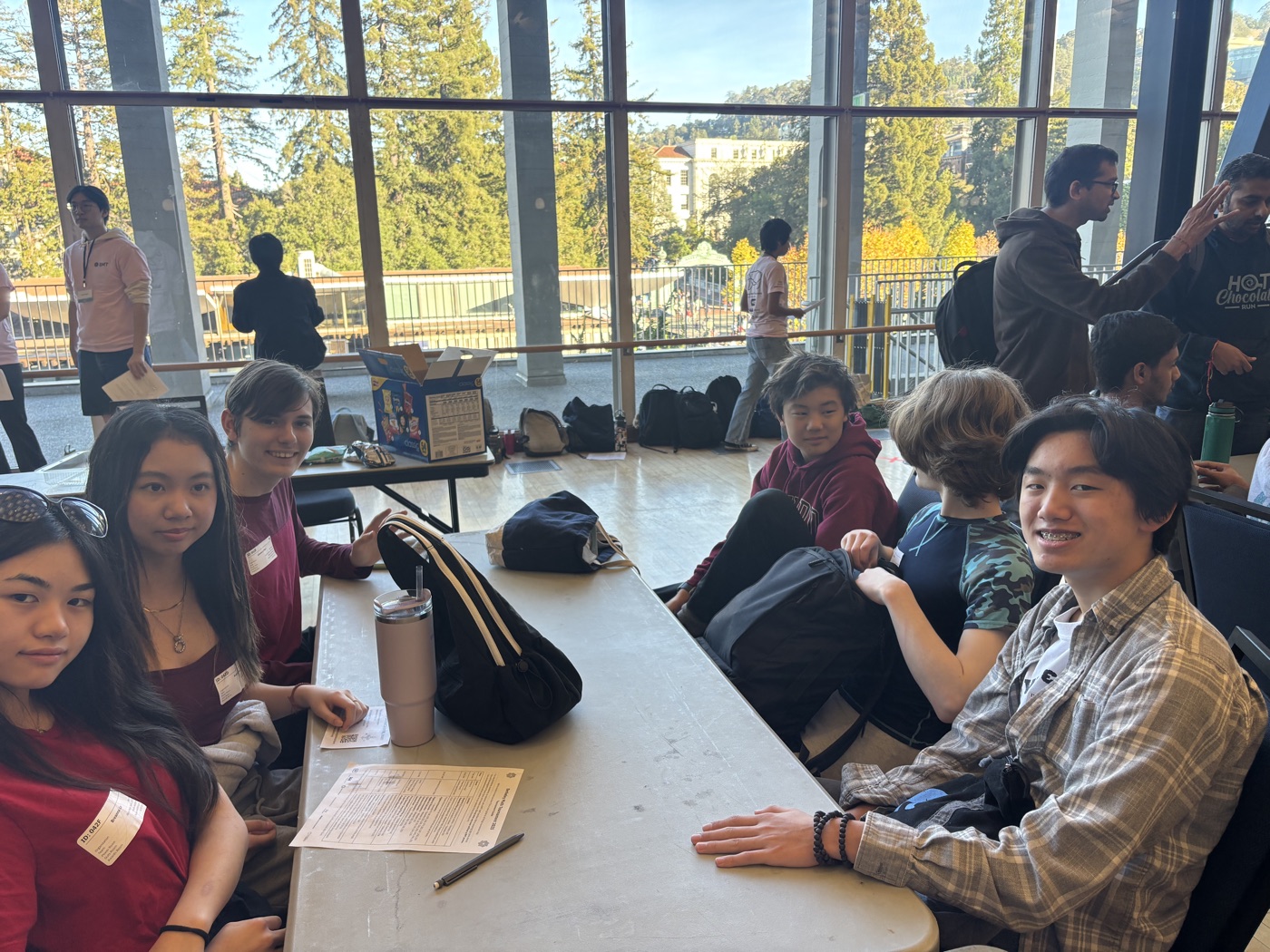
I founded Reno Math, a six-student team that competed at the Berkeley Math Tournament. I volunteer as a tutor with NVMath, helping instill a love for math in younger students. I also write original problems for the grades 1 to 8 levels of MathRocks, NVMath's monthly competition in Reno for grades 1 to 12.

Etienne and teammates at a math tournament
With my teammates at a math tournament in Berkeley.
Robotics

FIRST Robotics

I've been building robots since 4th grade, starting with robotics classes. For the past three years I've been a member of the local Reno community robotics team.

I design robot components in Onshape, from drivetrains to manipulators, turning game strategy into parts that meet field rules and weight limits. I also raise funds at local events, write grants, serve as a member of the pit crew, and scout other teams during competitions.

  • 2026Competed at the FIRST World Championship, Houston
  • 2026Rookie All-Star Award, Las Vegas Regional
  • 20265th alliance captain, Idaho Regional
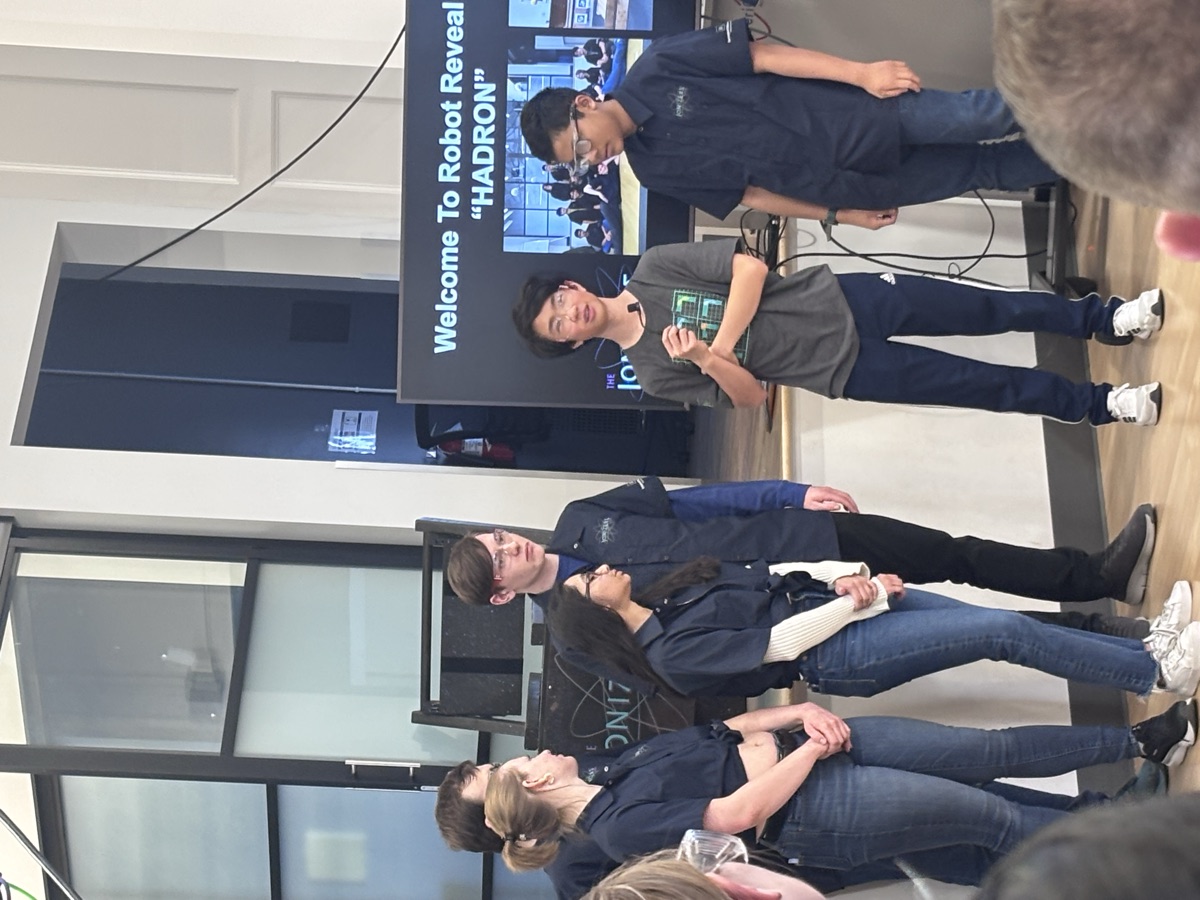
Etienne with teammates at the reveal of the team's robot, Hadron
Our robot reveal for Hadron.
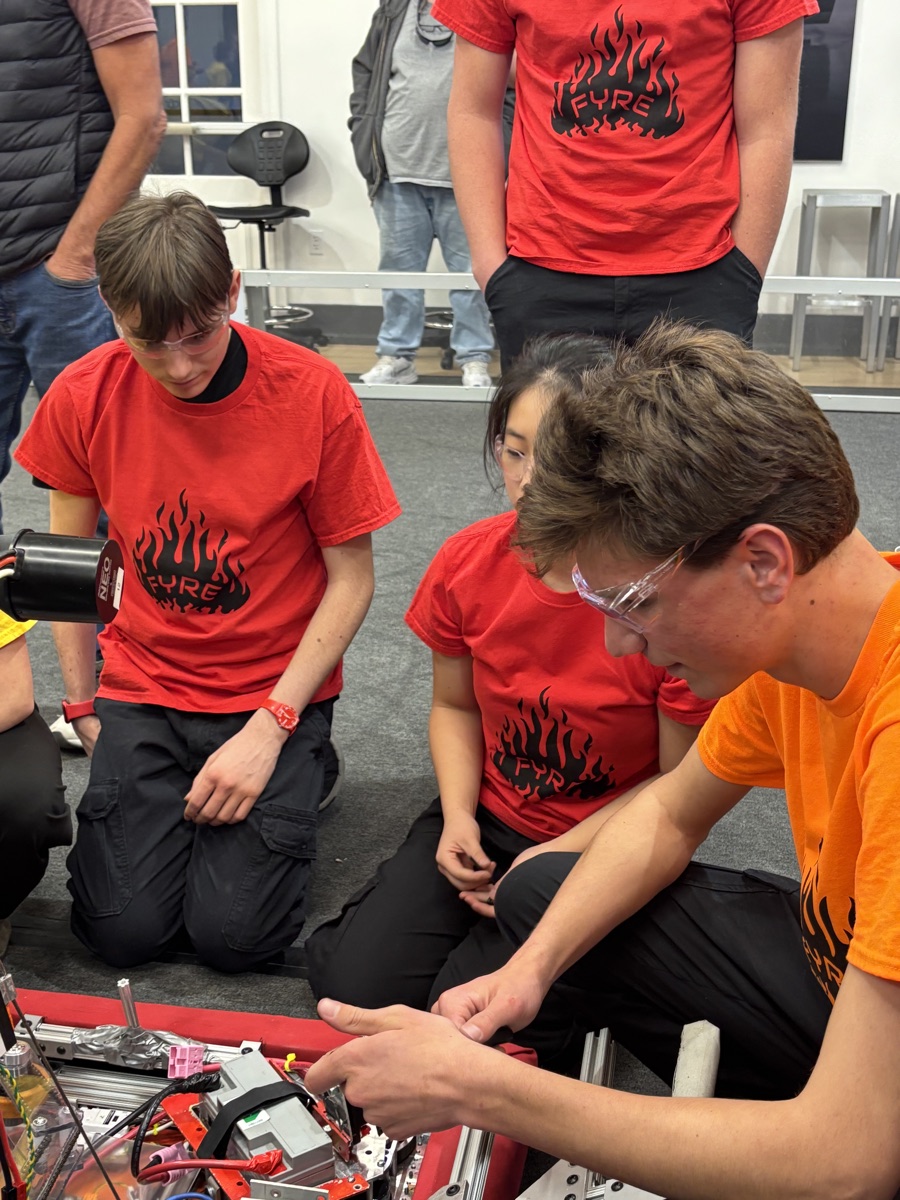
Etienne working on the robot's wiring with teammates
Working on the robot with my teammates.
Enrichment

Enrichment programs

Euler Circle

  • Fundamentals of Higher Mathematics
  • Infinite Series
  • p-adic Analysis

Fall 2025 to Spring 2026 · college level

Art of Problem Solving

  • Intermediate Algebra
  • Intermediate Number Theory
  • Calculus
  • Infinity Seminar

Among several courses

AwesomeMath

  • Summer camp

Summer 2024

Harvard Computer Society

  • AI Bootcamp

June 2025

Davidson Institute

  • Davidson Young Scholar

2024 to present

Languages
  • Albanian
  • French
  • Spanish
  • Latin
Also
  • DebateSage Ridge debate team: researching social policy topics and competing in monthly tournaments against local high schools.
  • CommunityVolunteering in Truckee: weekly park cleanups at Donner Park and downtown, Wild River community fundraisers, and mentoring younger students.
  • ViolinTahoe Truckee School of Music.
  • Martial artsFreestyle Martial Arts, Reno.
Writing

The Trapdoor

Simple questions. Ugly answers. My newsletter on the math hiding inside everyday questions. I've published twice a month since June 2026.

  1. Oct 15Why there are only five fair dice in the UniversePlatonic solids and Euler's Theorem
  2. Oct 1The Last Good SpotWhy it's so hard to find a parking spot, and the 37% rule
  3. Sep 15Why do cicadas disappear for exactly 13 to 17 years?
  4. Sep 1What's the most efficient way to stack oranges?
  5. Aug 15Why do rivers all over the world curve the same way?
  6. Aug 1Can you predict where a billiard ball will go?
  7. Jul 15What's the best way to cut a cake fairly?
  8. Jul 1Is there a fastest way to shuffle a deck of cards?
  9. Jun 15Can a voting system ever be truly fair?

Read all posts and subscribe →

Books

Before The Trapdoor, I wrote and published two books as a child: